
3 February 2026
Article
49m², year 10, autumn 2025 | The anodes of sound

The fluid form of sound
Anoek Mensink’s work takes on a fluid form that constantly eludes definition. Sound is not silent, but a vibrating, invisible presence. During her residency at the 49m² in Zaartpark, Anoek enters into a relationship with an unlimited, overgrown garden by reading it through sound. In doing so, she focuses on the relationship between humans and their environment and creates awareness of our living environment. She broadens our perspective by allowing the viewer to reflect on their daily approach to the environment in which we live. For centuries, humans have been trying to make sense of existence through stories, fairy tales, myths and art.
Photography: Stijn Terpstra
Persephone’s journey
The start of her residency falls in the autumn of 2025, coinciding with Persephone’s return to the underworld. Persephone is abducted by Hades, the god of the underworld, because he has fallen for her beauty. Demeter, her mother, wastes away with grief. Her daughter is her heart. She consults many and searches everywhere. She ends up with Helios, the sun god. From his high position in the sky, he has seen everything and tells Demeter that Persephone has been abducted to the underworld. Demeter approaches her brother Zeus, who then makes an agreement with Hades. Persephone is allowed to return home on the condition that she eats with Hades one more time. She eats six pomegranate seeds. But anyone who eats in the underworld cannot return to the world above. For every seed she eats, Persephone must return to the underworld for one month each year. So it happens that every year she is with Demeter in spring and summer, and returns to the underworld of Hades in autumn and winter. With the return of Persephone, autumn and winter begin each year. It is an explanation for the seasons.
In late summer, I meet Anoek in Zaartpark, where she explains to me for the first time what 49m² is. We are standing on a marked-out piece of land in the middle of the park; a piece of unmanaged nature.
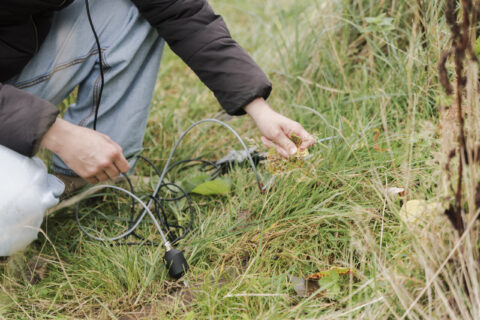
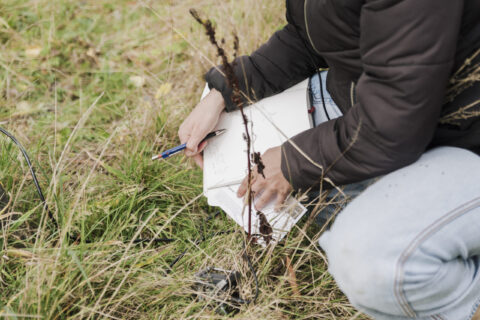
Anoek wants to communicate with nature in this place, give it back its voice and establish a relationship with it, or create a connection between us and the land. As we stand there, she sticks an awl connected to a recorder into the ground and searches for the meaning of the place. She listens to sounds on a micro level and concludes: ‘Life talks to itself and I can listen in with the microphones. Somewhere between spectator and participant.’
Perhaps we are catching something of Persephone’s journey to the underworld. When it is officially winter, I think she has arrived at Hades. Does she stay for a few days in the deepest depths of the underworld? Or does she return the next day and bring spring on time?
Anoek, have you heard anything?
The movement of sound
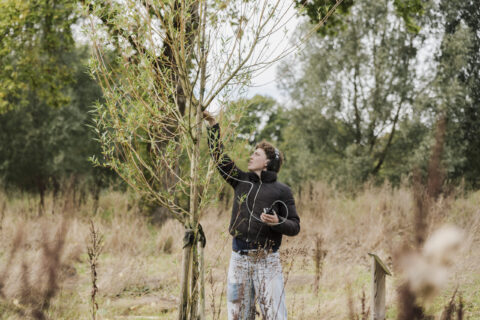
In the anodos[1] of sound, Anoek shifts her attention and travels upwards with the vibration, past trees. She feels the drops on her face and absorbs the sound of the water. So far, she has not succeeded in merging with nature. Anoek is both spectator and participant, but she has not yet found a deep connection with Persephone. That is why she continues to search, absorb and move through space to understand with whom or what nature does speak. There is no direct conversation, rather a philosophical reflection — and that, in my opinion, is the essence of art.
Anoek shows that distancing herself enables her to delve deeper into the ground, thereby facilitating a tactile connection. She constructs a delay that gives her thoughts a different twist, and perhaps those of the viewer as well. Art is a common denominator that can be responded to without language: a conversation in the imaginary world.
Grip through art
It is actually a tragedy that we are unable to understand our environment. That is why art provides frameworks: it puts fences around the wild garden of life when nature turns into dense, overgrown vegetation.
Thanks to the frameworks Anoek provides us with, we are able to approach this place, 49m², differently. With her auditory research, she gives nature a voice and thereby reveals the human urge to make the intangible tangible. In contrast to the distance that is growing between humans and nature, driven by industrialisation, profit and capital, Anoek goes against the tide. She shows how the desire to turn the tide is growing. She contributes to this changing cultural trend and, through her art, seeks answers to restore the connection.
She began her work period with a sculptural idea: placing a tree trunk to create a panoptic view. But she let this go in order to seek the connection with nature in nature itself, not as a spectator or outsider. More and more often, I hear, read or see a conciliatory language towards nature. Anoek joins this discourse and thereby reveals a change in social and cultural thinking. She seeks connection, stands in the midst of nature and does not want to view it from a distance. She realises that she is part of the world and no longer distinguishes between humans and the environment.
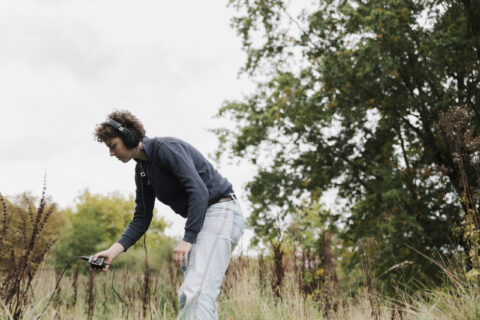
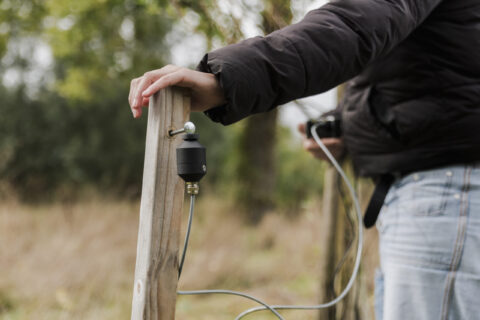
Anoek wants to capture sounds, but not those floating around in the air or those we already know. A normal microphone mainly records these sounds, so she uses different equipment. Probes and stickers that work like a microphone and are connected to a recorder with headphones. This allows her to record sound waves that occur in the ground. When I put on the headphones, I notice a monotonous, humming sound with occasional spikes. A loud sound, noise or deeper hum breaks through the monotonous sound. Later, she explains that these spikes are the material she works with. By combining them, she creates layers that slowly grow into compositions.
She comes up with a title: Fonie. The word has various meanings, which says something about the different types of sounds in nature. Anoek says: “Fonie means sound in Greek. Geophony refers to the natural sounds of non-biological causes, such as wind, water and thunder. This contrasts with biophony: the sounds of living creatures. Since the different episodes together form a combination of these two, I thought the word fonie was a good fit. The resulting songs summarise the image of autumn, with the rain and wind, but also with many hidden wonders that normally pass us by.” She then comes up with five titles for the songs. Each one says something about the content of a song: rough bark, under land, air tears, waving grass and fly away.
When I participate in the closing event of Anoek’s work period to listen to her EP together with others, I feel at peace. Silence descends and we listen to her work, mesmerised. The sound at the micro level belongs to no one. Anoek realises that she no longer needs to add or change anything to 49m². She wants to shed a different light on the place, and that happens at the moment of listening.
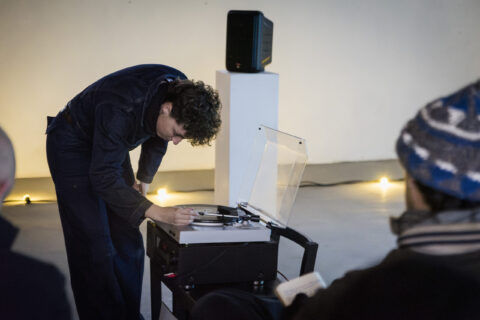
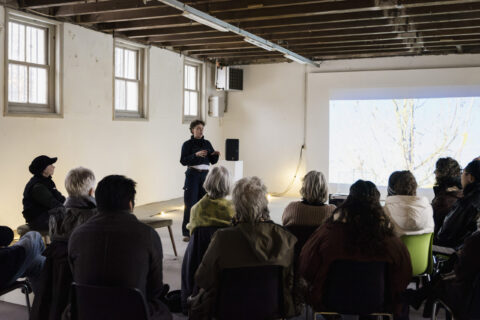
Anoek Mensink during the finissage of her residency, presenting her EP ‘Fonie’ with a listening session in de Stadsgalerij, Breda on January 9th 2026.
[1] The anodos implies the rising of a god from the sea or from the ground.
