
5 January 2026
Article
Being part of this universe, Barbara Schroeder

Artist Barbara Schroeder is originally from Kleef, Germany, and moved to Bordeaux 40 years with the intention to study at the art academy for just one year, but love kept her there. Not the romantic sort, but a deep and lasting passion for the region, its people, and its agriculture – in particular the vineyards – combined with the beauty of a landscape combining mountains, sea and gastronomy. But now Barbara is at the De Moeren estate, in Noord – Brabant. Upon my entering the historic barn, where Barbara lives and works for a month as Artist in Residence at the Van GoghHuis, the place is dark except for one single beam of light made by the projection of a film on an object that, after close inspection, seems to be the form of a house.
This is a special way of entering and seeing your film, is the film also one of the results of your residency?
Oh no, the film was made beforehand and produced very professionally by Jane Kleis; it would be impossible to create in such a short time. What I did during the residency was build the house and use it as a surface to project the film, as I had never found a satisfying way to present it—until now.
The house itself is very simple. Its proportions are based on the gulden snit (golden ratio), with a cube as the base and a triangle as the roof. It is built from locally sourced bamboo sticks and a cotton cloth coated with cow dung. The structure embodies the very essence of how we build houses.
Cow dung?
Yes, ‘koeiepoep’. I use this for several years. Actually, it is just hay and grass that is transformed in the cow.
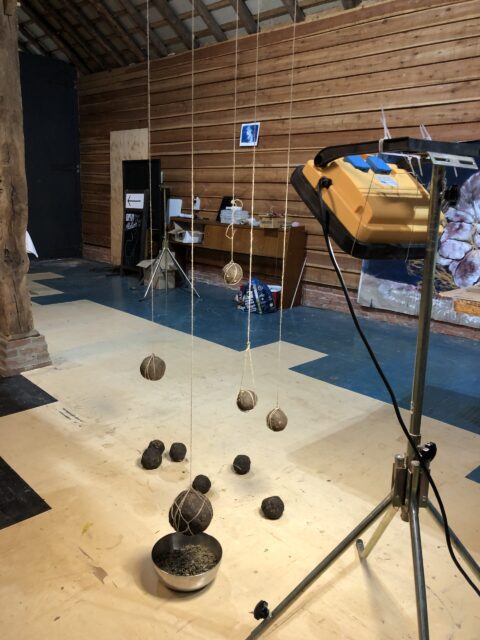
Photo by Esther van Rosmalen
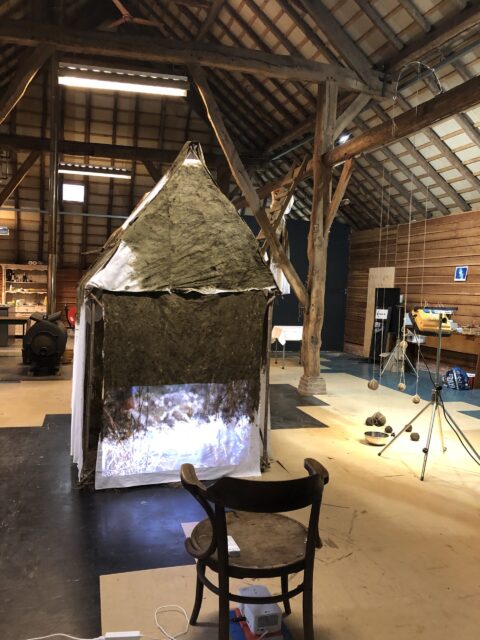
Photo by Esther van Rosmalen
But first I am curious how you end up here; have you ever visited this area before?
No, this is the first time I am here. I got in touch with the organisation thanks to Angus (Zhixin Angus Liau); he was one of the artists participating in this AiR program. We were both attending a residency in Brussels and he introduced me to Ron and Eva* when they visited him. They became interested in my work and now shown at the exhibition Patate in Zundert. It shows the works of artists, like me, inspired by the potato. I made a lot of potatoes in porcelain. An invitation for this residency followed, so here I am in a place I know absolutely nothing about.
Did you have a plan for here, or what do you wanted to explore?
First of all, I prepared to be here by developing a project connected to Vincent. Before arriving, I visited the Van Gogh Museum in Amsterdam, as I wanted to rediscover another dimension of his work beyond the iconic sunflowers.
My interest lies particularly in peasants and farming communities. Today, cities continue to expand, leading to increasing urbanisation, and we tend to forget about farmers. Yet farmers are essential: they shape the landscape and feed the world. Nature is not always gentle; it can also be harsh and demanding.
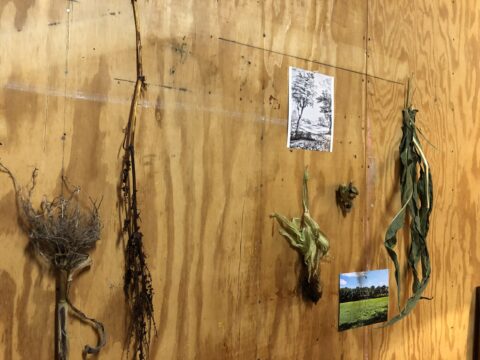
Photo by Esther van Rosmalen
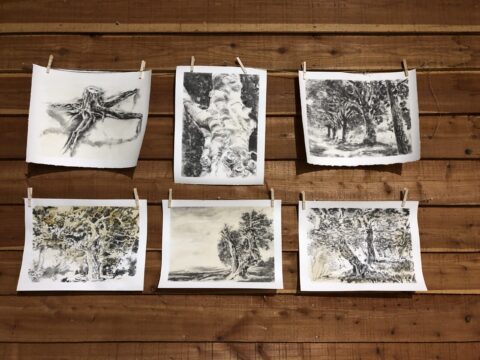
Photo by Esther van Rosmalen
What does attract you, the farming itself or the farmers?
The people. Without human beings, there is no project. That is why I arrived here without a predefined plan. It is essential to remain open to opportunities and not to approach a place with arrogance. The essence of my work is collaborative; without people, collaboration cannot exist.
And does the place fit your expectations? This is also an environment of nature and farming but I guess different to what you are used to in Bordeaux. What did you find here?
The environment offers a rich source of inspiration, with the presence of a national park and a strong local community. Being here has constituted a complete working and living context for my practice. I met farmers, who actively supported my research by helping me source the materials necessary for my work.
They assisted me in obtaining bamboo and in identifying an appropriate source of cow dung, as it was essential for me to work with a non-industrial farm. Cow dung from ethically raised, well-fed cows has no strong odour, unlike that produced by cows fed with artificial diets.
But behind me is a photo of something completely different. What is it?
One day a farmer came to me with maize infected by a fungus called ‘maïsbrand’. The result is both beautiful and unsettling. While farmers view it as a disease and are concerned when it appears, I find it aesthetically compelling.
After photographing the maize, I began to paint. The process was primarily about exploring its shapes and colours. Inside, the maize contains a black powder, reminiscent of charcoal, which I then used to paint with, employing an acrylic binder to fix it.
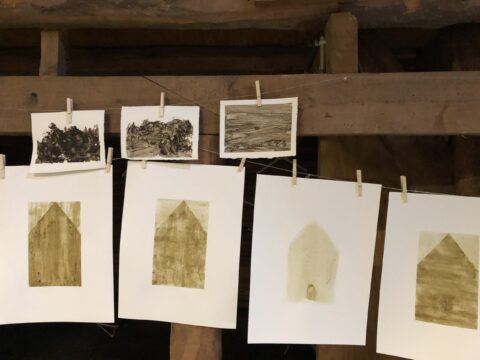
Photo by Esther van Rosmalen
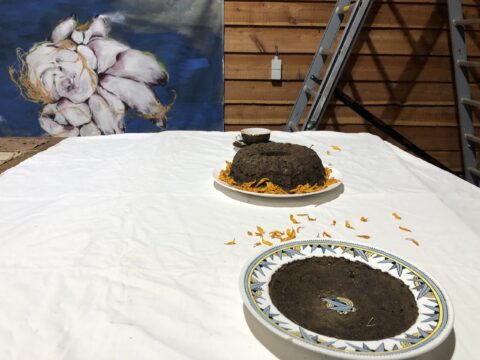
Photo by Esther van Rosmalen
Could that powder be dangerous for your health?
I don’t believe so. I researched it, and in some countries it is even considered a delicacy. Therefore, I believe it is safe to use.
Barbara is giving me a tour through the barn to see her works and put more lights on. At first she shows me a sort of planets, but actually they are dark spheres hanging on ropes. They are made of cow doo and inside of each of them is an acorn that Barbara found here. Another work is a small installation made of white dresses, also dipped in cow doo.
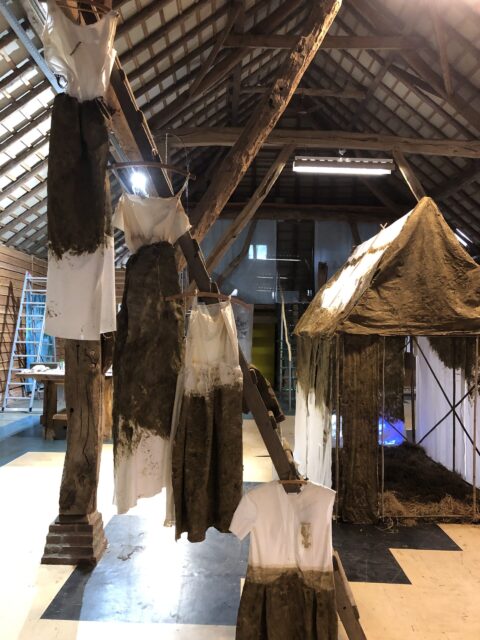
Photo by Esther van Rosmalen
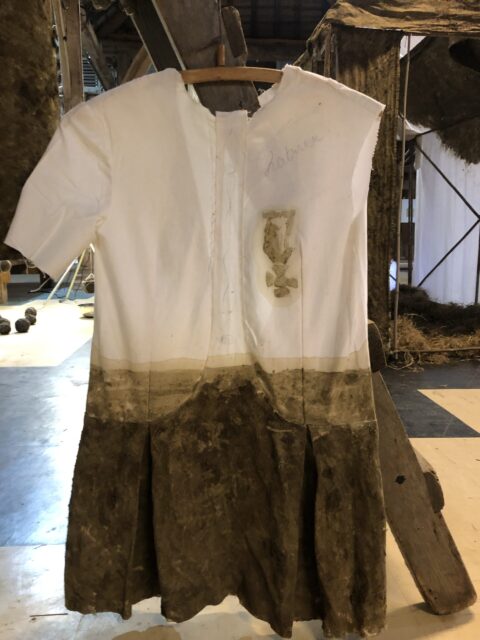
Photo by Esther van Rosmalen
This work is an homage to women farmers, who are often forgotten. I received all of these dresses from members of the local community, including unfinished ones. It is one of my favourite pieces created here, alongside the drawings.
The drawings on paper are studies—one must always study and observe carefully. Even the paintings, although they won’t be finished in time, helped me refine my vision.
I am very pleased with the house; it embodies the volume I had imagined. While compromises are often necessary, this time it feels complete. The projection serves as a kind of window, extending the spatial experience.
Have you built a house before?
Never. I hope to take this house with me—I just need it to fit in my car. If I had more time, I would have covered the panels with more cow dung. The purpose of the house is to reconnect us with the cycle of life.
Actually, I have made a very small house before in Brussels. It was constructed from small cubicles, like the toy bricks children use to play with, and was conceived as a reflection on building the future.
There are just a few days before the residency comes to an end. What will you be doing in the remaining time?
During these final days, I am focusing on creating large drawings on canvas using cow dung and black maize-bran powder. I prefer working on canvas because paper is fragile and requires protection behind glass. For me, canvas feels like a second skin—it carries its own color and presence, whereas paper is simply plain white.

Photo by Esther van Rosmalen
And what will be the experience from here that you take with you?
When I arrived, I chose to remain open and to immerse myself in this environment. One challenge was the lack of daylight in the barn—there are very few windows—but such limits can also be valuable. I was fortunate to be here during the summer, the best season for this experience. The space offers many possibilities, and overall, it has been a beautiful experience, enriched by the kindness of the local community. For me, meeting the people of the place is essential. I walked and biked extensively, but without the people, the experience would not have been the same. I often left my door open so that visitors could enter freely.
In these final days, I am focused on completing my work, and the space has become more private. Vincent has also maintained the right distance, allowing me the necessary room to work.
Esther van Rosmalen, August 2025
* Ron Dirven is director of Vincent van GoghHuis Zundert and Eva Geene is curator of the AiR Van Gogh program.