
14 July 2026
Article
49m², year 10, spring 2026 | A sweet border

Desire paths
Desire paths are developed by people that keep choosing the same path. Not the official route, but the shortest. Slowly the grass disappears and a path appears. They reveal how people actually move through a landscape, released from what was once designed. To urban designers they provide information. They do the same for artists, which is apparent when you arrive at 49m² in Zaartpark.
Esther Hoogendijk (1987) almost immediately points these paths out to me. They form an arc around a square patch of land. They were not laid out; they emerged. People walked around the square. Not because of a fence or a rule, but because of a simple intervention by Esther: tulips. Ultimately it was not the flowers that were the subject, but the boundary they mark.
“Actually I was supposed to do this residency last year,” Esther explains. “Because of the birth of my son things changed.”
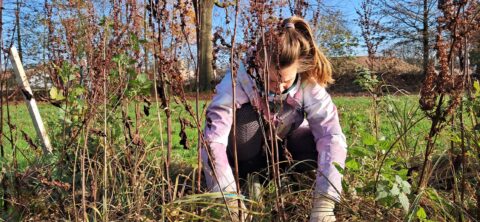
Tulips
The delay turned out to be a part of the work itself. The extra time led her to a bulbous plant that blooms precisely during the residency: the tulip. However, this brought up an uncomfortable question.
The delay turned out to be a part of the work itself. The extra time led her to a bulbous plant that blooms precisely during the residency: the tulip. However, this brought up an uncomfortable question.
I keep coming back to that word: cheating. As if an artwork is only allowed to begin once the official working period starts. As if nature cares at all about an artist’s schedule. Maybe the work begins with that very doubt. Not the tulips, but the question of how much control an artist wants to have.
That question runs like a thread through Esther’s practice. Her sculptures and installations slowly change shape, colour, and material. Evaporation, decomposition, growth, touch: her works show that time can not just be measured, it leaves its mark on material things. She does not create objects that capture a moment, but rather the conditions for change to become visible.
“I realized I don’t want to keep looking at the same work. I look for the art that lives, that transforms, that visibly bears the creation process. I love it when someone comes back later, wondering how the work will have changed. I think we’ve lost some of that attentiveness to change.”
Even the choice of the tulip turns out to be less self-evident than it appears at first glance.
“I had sent messages to a lot of tulip farmers about my idea. In the meantime I found myself thinking: What am I actually doing? Tulips aren’t exactly an innocent product.”
The tulip has a marked history. In the seventeenth century, the flower became an object of speculation . During the Dutch Tulip Mania, it was not so much the flowers that were traded, but expectations. The value lay not in the tulip itself, but in the desire attached to it.
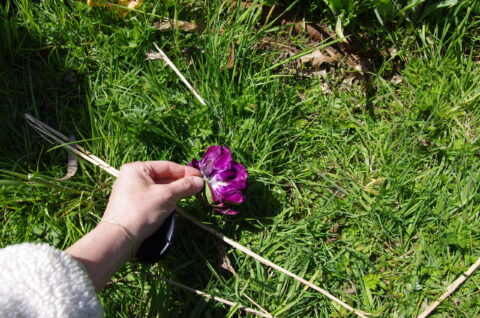
The Border
Even today there is a notable gap between image and reality. The tulip is a symbol for spring, beauty, and purity, yet Dutch bulb cultivation remains one of the agricultural sectors that uses relatively high levels of crop protection products. Behind the fleeting bloom lies a carefully controlled system of production, selection, and protection.
“An organic grower couldn’t supply it, Eventually, a large-scale grower responded. It turned out he is a collector of art. We struck a deal: he received a work of mine, and I got the bulbs. He also really helped think through which varieties would be suitable.”
She laughs.
“So I did succumb to the expertise and cooperation of a giant.”
Once the bulbs were available, the next decisions had to be made. How many tulips? A few? The entire field?
“Then I decided I should do a border.”
Not in the middle. The border. In hindsight this decision turned out to be the core of the work.
“At first, I wanted to place the bulbs on the outside. Then I thought: no, they need to be inside the square. But then you start wondering: do I actually want to break out of that frame? In the end, it wasn’t about the tulips at all. It was about our need to put a border around something.”
Borders seem self-evident, until you ask why they are there.
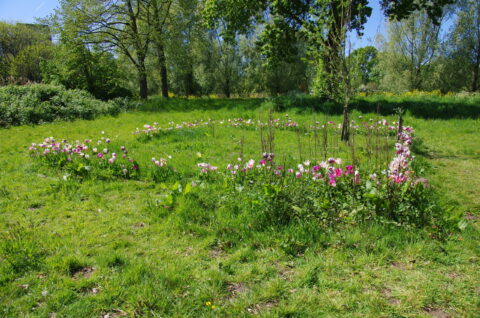
A sweet border
Later, Esther shows me a book she had just bought in a thrift store in Breda:Borders in and around the garden.. Some time after that she sent me a passage: “A garden is only a garden if the space is enclosed. The English word garden is rooted in the Proto-Germanic gardô (enclosure).
It’s not the land that makes the garden, but the boundary. First comes the fence, and then the inside and the outside. Perhaps the same applies to ownership. The tulips do not form a hard boundary. There is no fence. No ribbon. No “No Entry” sign. Yet something striking happens when the flowers are in bloom.
“People all walked to the sign that is still there from another project, no longer legible, and then walked around the edge of tulips. You can see exactly how they moved. No one stepped in amongst them. Apparently, they felt a certain sense of respect after all.”
“I am still curious about what would have happened if I had placed a fence instead of flowers. Would people still have walked around that?
“I am still curious about what would have happened if I had placed a fence instead of flowers. Would people still have walked around that?
At the same time the work brings up bigger questions. Why do we often protect borders more zealously than the people excluded by them? Why do we regard tracts of land as property, when the landscape pays little heed to the lines we draw on maps? The tulips don’t seem to answer those questions, but they do make them visible.
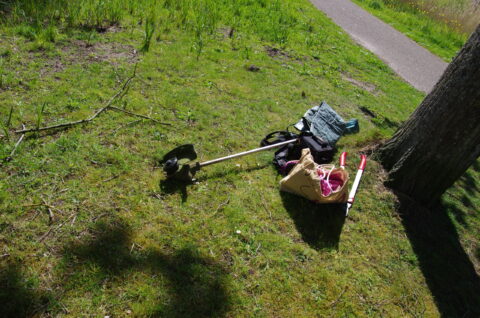
Letting go
I keep noticing more and more during our conversation that Esther is not only exploring how a work changes, but also how little intervention is sometimes required. Three times she went out to the field with a shovel and a grass trimmer. Three times she decided to do nothing.
“I thought: I’ll make that edge more distinct. Or I’ll mow everything flat. Then I thought: no. That’s not my strength at all. I was just doing something because I thought I had to.”
In the end, she didn’t want to pick the tulips themselves either.
“When they were in bloom, I thought: I’ll take a flower from each variety. But in the end, I only took what was already on the ground. The seed pods I have now also snapped off by themselves. Leaving things be is important.”
She only takes that which the plants let go of themselves.
Ultimately, the tulips prove to be not just a work of art, but an invitation to look. The worn paths reveal how a subtle intervention manifests in a change in people’s behaviour. Perhaps that is Esther’s most radical intervention of all: not creating more, not perfecting, not correcting, but simply choosing to look.
In many Indigenous traditions, knowledge arises not only through analysis but also through sustained, attentive observation. The concept of Two-Eved Seeing, developed by the Mi’kmaq elder Albert Marshall, invites these two ways of seeing to coexist: the analytical perspective of science and the relational perspective born of experience and reciprocity. The goal is not to find a single truth, but to learn to see more exceptionally.
In this work, too, looking becomes a form of action. It is not the artist who ultimately determines what the work becomes; time, weather, plants, and visitors all play a part.
At the end of our conversation I am reminded of The Garden by biologist and writer Dick Hillenius. After purchasing a plot of farmland, he decides to leave the land largely alone. The nettles, he writes, sometimes annoy him. He mows them down occasionally, but then reflects on the fact that birds and butterflies depend on them. In the end, he keeps only a few paths cleared. The rest is left to do its own thing.
Just like Hillenius, Hoogendijk also discovers that not every intervention needs to be made. It is precisely in letting things be that space opens up for something that cannot be planned.
While I walk away, I take one more look at the worn-in paths around the square. They were not planned. They developed because people, each on their own, chose the same gentle detour.
“Leaving things be is important.”