
Het Aktiverend Volksteater

As part of the Spain Projects, Witte Rook has invited artist David Maroto. In his research, he links the shared Spanish and Dutch history to two events from the recent past: the death of the Spanish dictator Franco in 1975 and the performance of the play ‘Franco de tweede’ by the Breda-based ‘aktiverend volksteater’ in 1976. These events cannot be viewed in isolation from the Spanish Civil War and his own family history, with David exploring his research through memory and oral tradition.
Family history
In his work, he explores the extrajudicial execution of his grandfather Manuel, which took place during the Spanish Civil War that erupted following General Franco’s coup d’état in 1936. David reconstructs this history of violence, and how it is embodied in a personal experience and his family history – which remains suppressed by a silence from which memory must be restored. His grandfather, for instance, was neither a soldier nor a figure of political significance, but a farmer who led a simple life with his family in a small town. Many decades and changes of government later, the Spanish state still refuses to open the mass grave where Manuel lies, thereby preventing the identification of the estimated 400 victims and denying relatives closure by denying them the opportunity to reburial the missing in dignified circumstances.
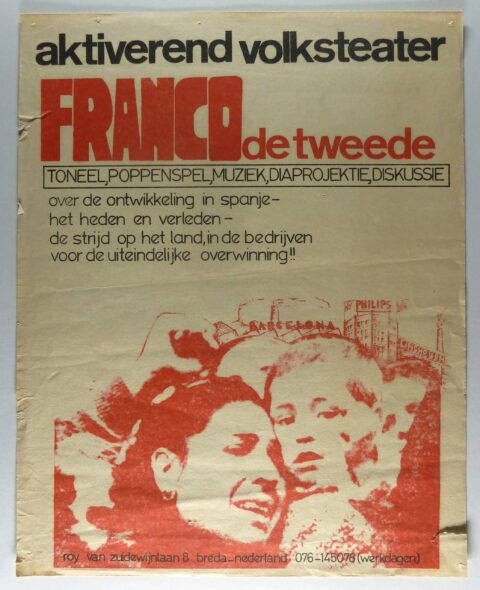
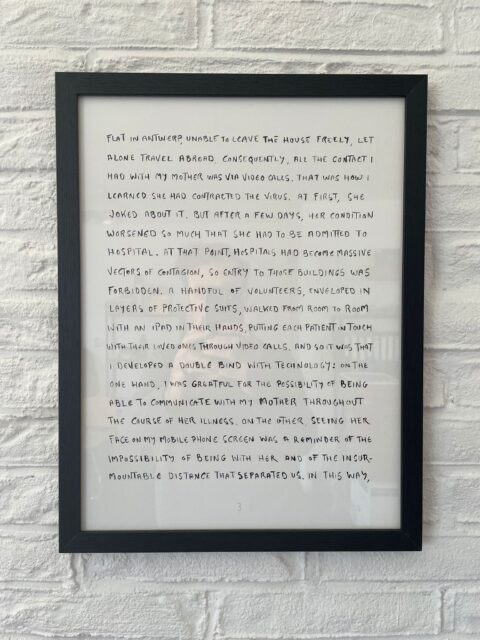
Photo David Maroto
‘Franco de tweede’
‘aktiverend volksteater’ is the name of a group of Dutch performers, filmmakers and cultural activists who were active in Breda in the 1970s. In 1976, they staged a play entitled ‘Franco de tweede’, which dealt with the legacy of the Spanish dictator and his appointed successor, King Juan Carlos. In the play, actors interacted with puppets, music and slide projections, and in that sense anticipated interdisciplinary productions. ‘Franco de tweede’ was performed during a decade in which the Netherlands became a refuge for Spanish exiles from the Franco regime. The ‘aktiverend volksteater’ sought to raise awareness and foster solidarity with the struggle in Spain against fascist oppression.
David is creating new work based on research into ‘Franco de tweede’ using archive material from the Breda City Archives and through interviews with those involved, such as former members of the group (including Bob Entrop and Gerard Arkink). The aim is to reconstruct materials (puppets) as used in the performance, but also to gain a better understanding of how it was received by the public and the media, in order to sketch a picture of the spirit of the times. By drawing a parallel between his own family history and this specific play, David connects various aspects of contemporary Spanish history on multiple levels from a Breda perspective.
Transmission School
In the project Het Aktiverend Volksteater, David Maroto draws on his methodology as an artist by incorporating the various elements that form part of his artistic practice. One example is the concept of possession, or the possibility of allowing ideas, thoughts and emotions to travel from body to body through time – even after death. In the tradition of passing on stories and histories from generation to generation, David has developed a method called Transmission School, in which oral transmission takes place. Through objects, structures and unwritten agreements, information is passed on and imbued with new meaning. In this project, he will collaborate with performer Jessica van Deursen, who will activate the installation by replacing the usual explanatory text with verbal communication. She will guide visitors using objects such as clay busts, murals and drawings, which she employs as memory aids to tell the story. This creates interaction with the visitor and opportunities to reflect on the fundamental relationship between artistic creation, speech as forms of communication, and the preservation of future memory. A parallel can even be drawn with puppet theatre: the performer fulfils a similar role in which she puts her body at the service of the story, in this case David’s research.
The presentation of this project will take place in June 2026 at the StadsGalerij in Breda in the form of an exhibition in which the research will be shared through performance.
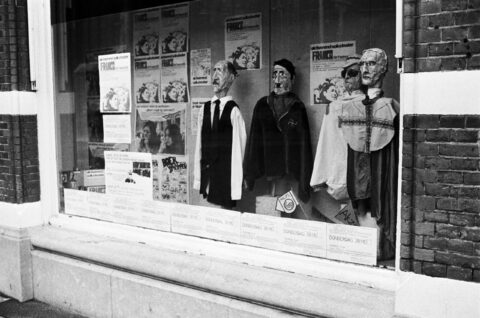
Photo BN De Stem & Johan van Gurp, JVG19760513034, collection Stadsarchief Breda
Context
Breda and Spain share a rich history full of illustrious figures such as King Philip II of Spain and William of Orange, the Father of the Fatherland. Breda’s pivotal role is even immortalised in Diego Velázquez’s world-famous painting La Rendición de Breda (1634–1635), which hangs in the Prado Museum in Madrid. Monuments and street names also mark this shared history with Spain, making it recognisable in various ways in everyday life. However, history is merely a collection of facts and interpretations.
General Franco’s legacy following the transfer of power to King Juan Carlos, the head of state, has had consequences that are still felt in Spain today. This project coincides with the 50th anniversary of the play ‘Franco de tweede’ (1976-2026), nd follows on from the celebration of 50 years of transition in 2025, marking the birth of democracy in Spain. A moment to reflect on the innocent victims, but also a moment of solidarity as depicted in the ‘activating folk theatre’ piece. Because history is not an isolated phenomenon and resonates within society, it is important to continually add new perspectives to it. This project achieves this by not only focusing on the history of Spain with a capital H, but also by looking through the lens of personal experiences.
About David Maroto
David Maroto is a Spanish visual artist based in the Netherlands. In 2019, he was awarded a PhD by the Edinburgh College of Art (supervisors Maria Fusco and Jane McKie), in collaboration with the Dutch Art Institute (DAI), where he had previously obtained his MFA. His doctoral project is entitled The Artist’s Novel: The Novel as a Medium in the Visual Arts, dwhich was published as a two-volume book by Mousse Publishing, also in 2020. A Spanish translation of this book was recently published (Greylock Editorial, 2025). As a visual artist, he has developed a long-term project in collaboration with Joanna Zielińska, Senior Curator at the M HKA (Museum of Contemporary Art in Antwerp), entitled The Book Lovers. Since 2011, they have been working on the creation of a collection and bibliography of artist novels with the support of the M HKA. David has published numerous artist novels, essays, interviews and articles, and has edited various publications, including Artist Novels (Sternberg Press, 2015); Tamam Shud (Sternberg Press, 2018); and the article ‘Valid Fictional Contributions to Non-Fictional Debates: Fictocritical Writing in Artistic Research’ (Acta Academiae Artium Vilnensis, 2023).
About Jessica van Deursen
Jessica studied fine art at the Willem de Kooning Academy in Rotterdam, Performance Art & Community Art at Codarts / the Piet Zwart Institute (Master’s in Art Education), and took a minor in Philosophy at Erasmus University Rotterdam. In her artistic practice, she creates sensory performances, music, rituals, speculative tools, interactive online video works, performances and installations.
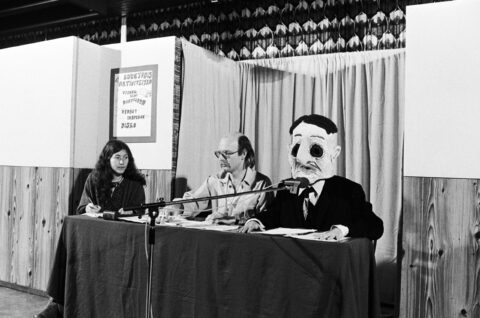
Photo BN De Stem & Johan van Gurp, JVG19781028028, collection Stadsarchief Breda